
Lumistep Glasses
Glasses you would choose for how they look.
Lumi happens to live inside. Designer frames with a tiny Lumi Vision sensor hidden in the corner and open-ear speakers hidden in the temples. Ask, and Lumi answers in a calm voice only you hear.
Planned price, full kit with cane and app: $199 · £149. Nothing is for sale yet.
Concept image. Lumistep Glasses are in engineering development.
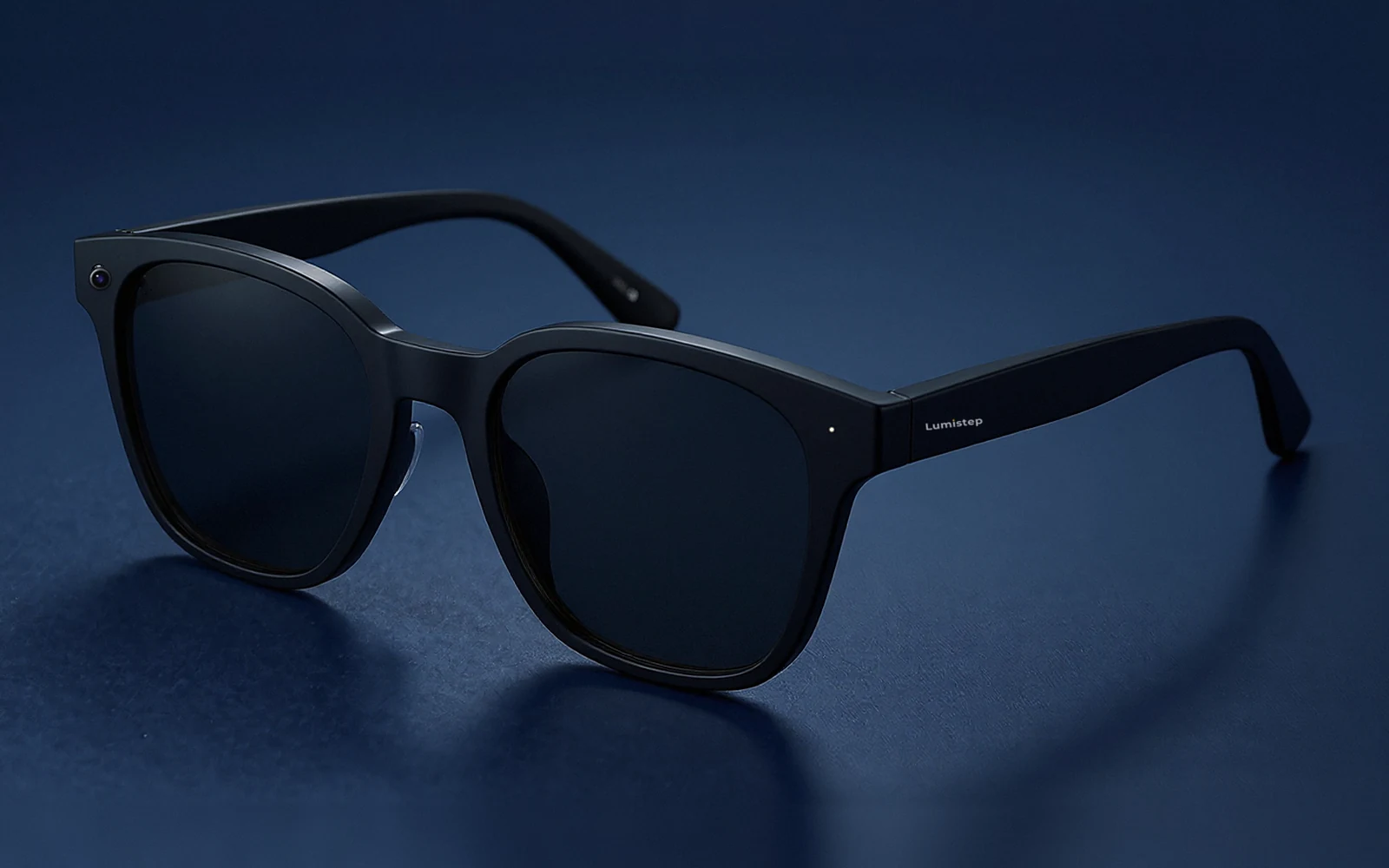
Classic and Classic Clear
Looks like the glasses you’d buy anyway.
- Lumi Vision, our ultra-low-power vision sensor, sits in the top outer corner of the frame front, at eye level. It is rated at about 3 mW[28]. Read mode adds a small greyscale camera that is on only while you read.
- A tiny amber light in the other corner. It is on whenever Lumi Vision is looking, so people nearby always know.
- Tap to talk to Lumi, read, answer or pause. Found by touch, never by sight.
- In the temples, just outside your ear. The temples are a little thicker than an everyday frame’s, so the speakers, chips and battery fit inside. Guidance and calls come through while you still hear traffic.
- The style many people choose first: dark lenses in a bold matte frame.
- The same frame with clear lenses, for people who want them to look like their usual pair.
- The case protects the glasses and tops them up on the go; the case charges by USB-C. The battery sits in the left temple.
Lumi Vision
Our ultra-low-power vision sensor.
Lasts much longer.
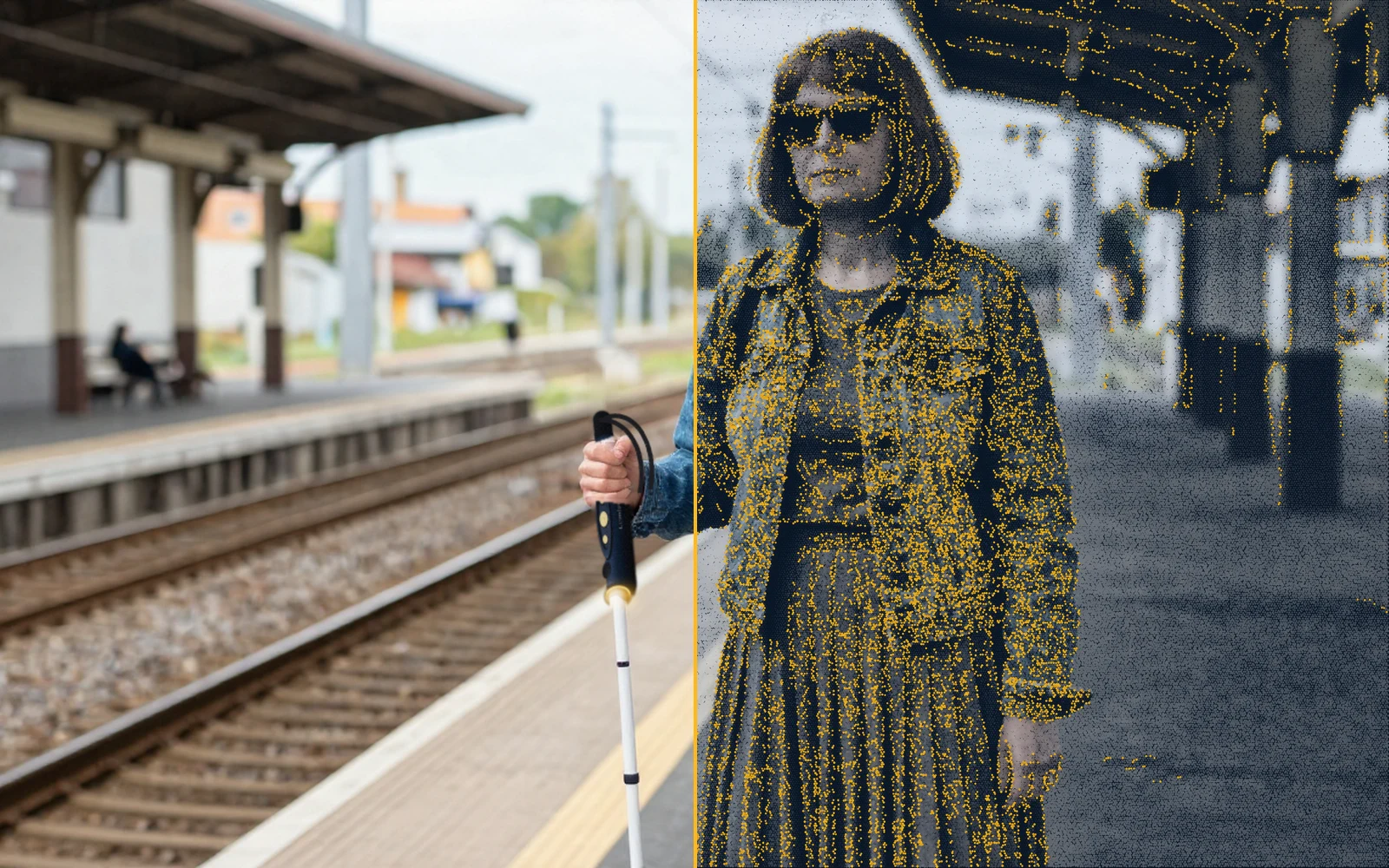
The sensor is rated at about 3 mW in normal use[28], and the chips behind it only work on what changed. That is how a small battery in the arm can aim for a full day (target).
Kinder on the price.
Less data means a smaller, lower-power processor and a smaller battery. That helps keep the whole kit at a planned $199 · £149.
Steady for years.
No moving parts, and it runs cool because it does little work when nothing changes. We expect that to help it last, and long-life tests check it before launch.
How it sees
From the street to a few calm words.
Step 1
Each pixel watches
320 × 320 pixels, each working on its own, with no shutter and no frames[28].
Step 2
Only change is sent
When the light at a pixel gets brighter or darker, it reports it within microseconds. A still wall sends almost nothing.
Step 3
Changes become shapes
A low-power vision chip in the arm turns those changes into edges, shapes and movement.
Step 4
Shapes become words
On-device AI decides what matters and says it briefly: “Person ahead, slightly left.”
Lumi, your assistant
Ask. Lumi answers.
Lumi and the cane, together
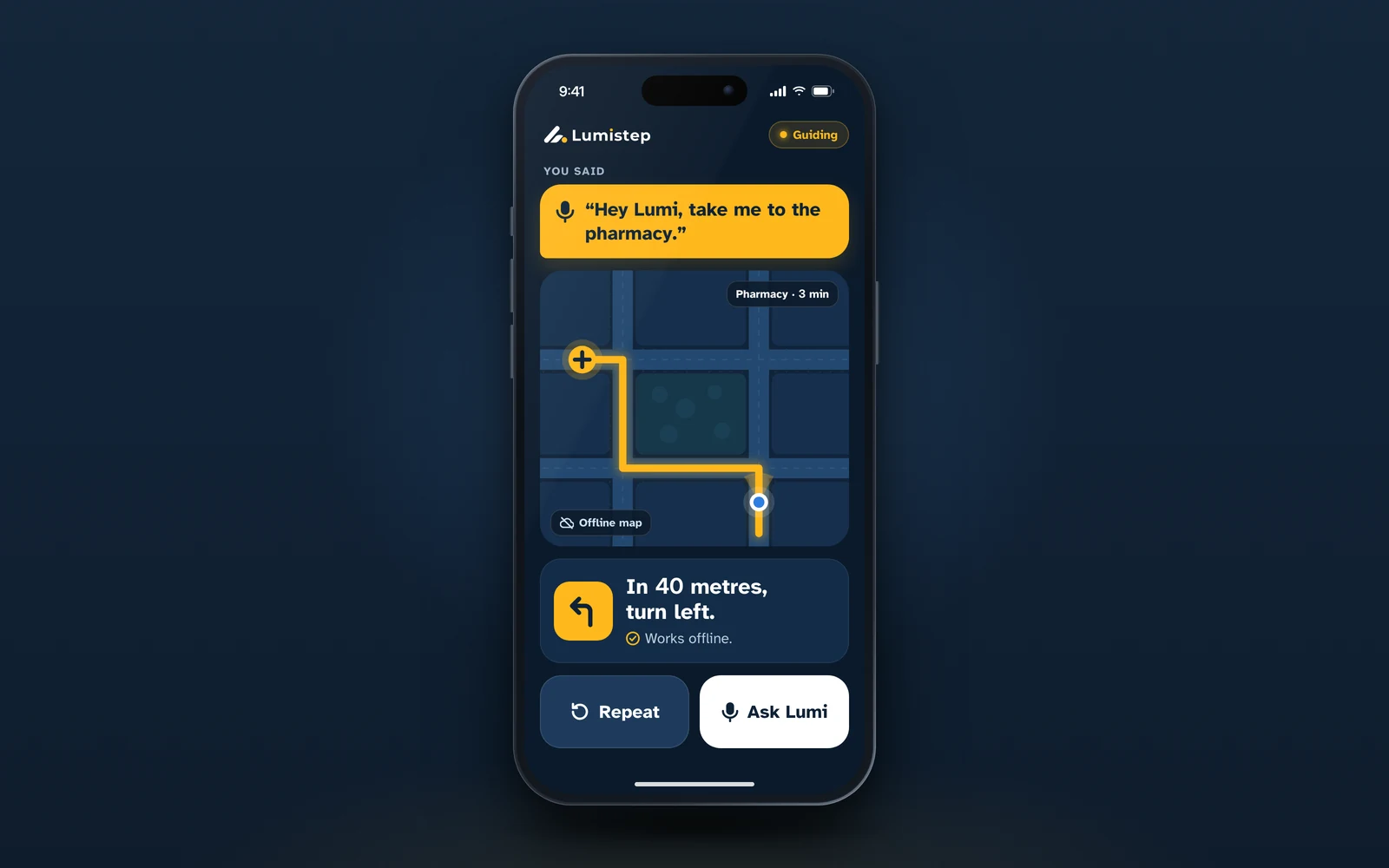
Walk with Lumi
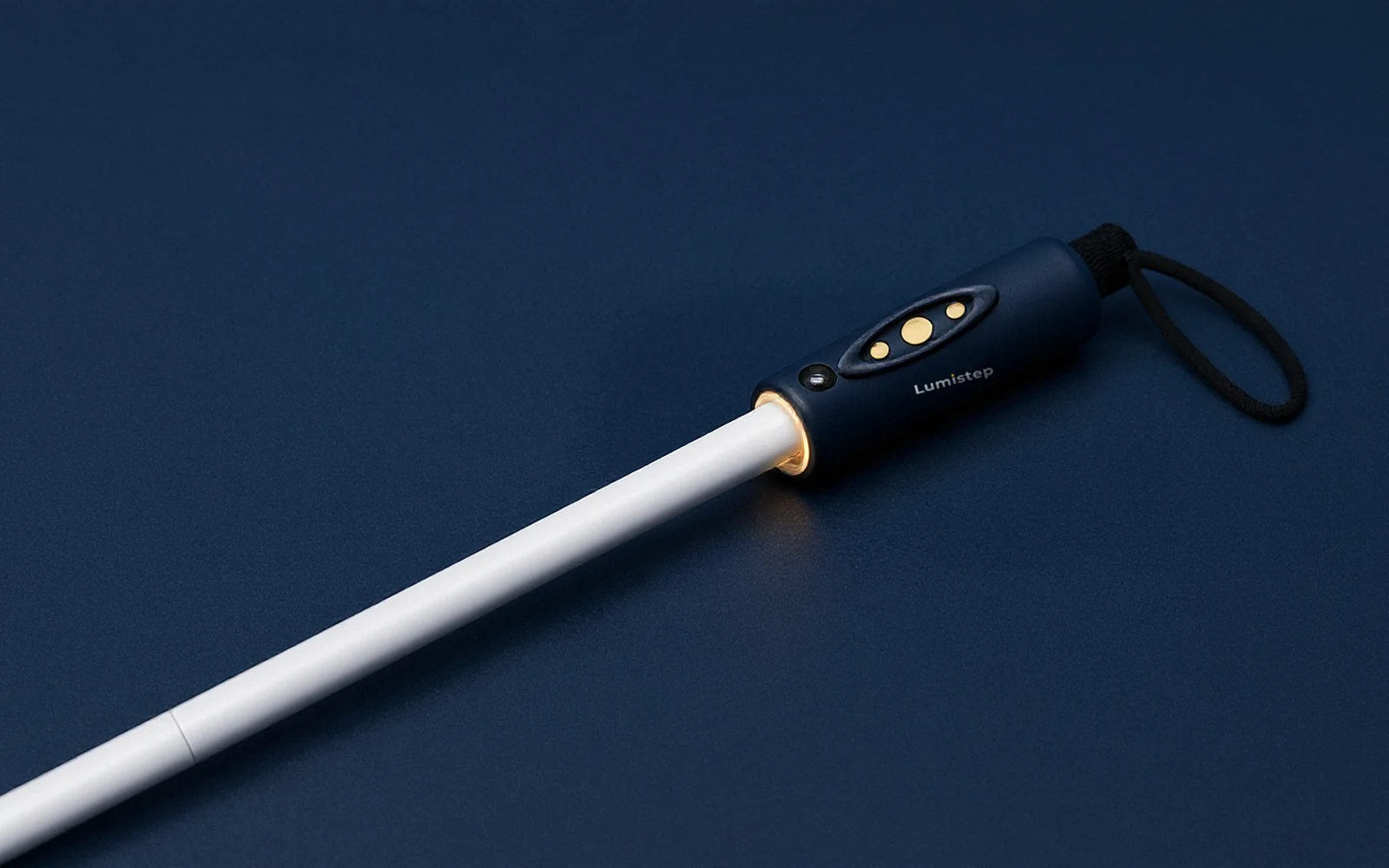
Turn-by-turn guidance from offline maps, with the cane’s left or right buzz at every turn. Only Lumistep pairs the voice with a smart cane.
You say: “Hey Lumi, take me to the pharmacy on Park Road.”
Lumianswers: “Head north. In 40 metres, turn left. Your cane will buzz on the left.”
Ask Lumi
Needs internetA real conversation in a natural voice. Ask what is in front of you, ask about a menu or a bus, then ask a follow-up.
You say: “Hey Lumi, what’s on this menu?”
Lumianswers: “Three soups, a fish curry, two rice dishes and masala tea. Want the prices?”
Read
Works offlineQuick read for signs, labels and screens. Read a page for letters, documents and booklets, in order, and jump back any time.
You say: “Read this letter. Go back a line.”
Lumianswers: “Page one of two. “Your appointment is on Tuesday at 10 a.m.””
Describe
Offline, richer onlineA short description offline. A richer one when you are online.
You say: “What’s in front of me?”
Lumianswers: “A shop doorway ahead, slightly right. A parked motorbike on your left.”
Find
Works offlineSpoken direction, plus a cane buzz toward the thing you asked for.
You say: “Find an empty seat.”
Lumianswers: “Empty seat ahead, slightly right, about four steps.”
Money, colour and light
Works offlineLocal bank notes, clothing colours, and whether a light is on.
You say: “Which note is this?”
Lumianswers: “A twenty-pound note.”
Known faces
On your device onlyOpt-in and off by default. Tells you when someone you have taught it is nearby. Stored only on your device.
You say: “Who’s here?”
Lumianswers: “Amina is ahead, to your left.”
Call a helper
Needs internetA family member or volunteer sees through the camera, live, and talks you through it.
You say: “Call Sara.”
Lumianswers: “Calling Sara. She can see your view now.”
Everyday
Offline, richer onlineTime, battery, messages and calendar through your phone. Weather when you are online.
You say: “What time is it? Will it rain?”
Lumianswers: “Ten past eight. Light rain after eleven.”
Memory
On your device onlyLumi remembers your places, routines and preferences on the device. Say “forget that” and it does.
You say: “Remember this is my bus stop.”
Lumianswers: “Saved as your home bus stop.”
Reading uses a small, low-detail greyscale camera that switches on only in Read mode. Lumi never decides when to cross a road, and offline answers are simpler than online ones.
A fair comparison.
Lumistep Glasses kit
- Price
- $199 · £149 for the whole kit, including the smart cane (planned)
- Ongoing cost
- Safety and navigation free forever; optional plans from $4.99 · £3.99 a month
- Smart cane
- Included, with left and right buzz
- Walking guidance
- Walk with Lumi, offline, with cane buzzes at every turn
Envision Glasses
- Price
- $1,899–3,499[35]
- Ongoing cost
- —
- Smart cane
- None
- Walking guidance
- —
Ally Solos Glasses
- Price
- $399–699, with a year of the Ally Pro plan[36]
- Ongoing cost
- An Ally Pro plan after the first year
- Smart cane
- None
- Walking guidance
- —
| Lumistep Glasses kit | Envision Glasses | Ally Solos Glasses | |
|---|---|---|---|
| Price | $199 · £149 for the whole kit, including the smart cane (planned) | $1,899–3,499[35] | $399–699, with a year of the Ally Pro plan[36] |
| Ongoing cost | Safety and navigation free forever; optional plans from $4.99 · £3.99 a month | — | An Ally Pro plan after the first year |
| Smart cane | Included, with left and right buzz | None | None |
| Walking guidance | Walk with Lumi, offline, with cane buzzes at every turn | — | — |
Envision and Ally Solos prices from Envision’s public listings; a dash means the feature is not listed there. Lumistep is in engineering development and nothing is for sale yet.

Day, night and reading
Strong in glare and dark. Honest about reading.
Harsh sun on a wet road. An unlit lane at night. An ordinary camera often sees white glare or black. The sensor is rated for over 120 dB of light range[28], so both are workable.
Reading is the hard part. A still page in front of a still sensor produces very little change to work with. Researchers have read text this way, even in low light[30], but it is new science.
So Read mode uses a small, low-detail greyscale camera that switches on only while you read. Everything else stays on Lumi Vision.

Privacy
An amber light whenever it looks. Nothing stored by default.
The teacher at the gate. The man at the tea stall. The people around you should know when your glasses are looking, so an amber light shows whenever Lumi Vision is on.
Europe's data protection regulators have asked smart-glasses makers for recording lights that people can see and that cannot be covered[14]. We are designing to that, in our brand colour, so it is never mistaken for glare.
Nothing is stored by default. Processing happens on the device first, and anything sent online is your choice, on a plan you pick.
Glasses or buds?
Who should choose glasses.


You wear a hijab or a scarf.
The sensor sits at eye level, clear of the fabric, and nothing has to go inside your ear under it.
You already wear glasses.
Or dark glasses. Swap them for a pair that also sees, speaks and takes calls.
You want to read and describe.
In a US study of blind workers, people with smart glasses used them most for reading (83%) and describing objects[12]. The sensor follows where your head points.
You want fewer things to handle.
One device, one touch strip, no tiny buds to drop. A good fit for many older users.
Compare
Built for walking, not for selfies.
Lumistep Glasses
- How it sees
- Lumi Vision: processes only what changes[28]
- Sensor power
- About 3 mW (component rating)
- Sun and dark
- Over 120 dB light range (component rating)
- What is kept
- Nothing stored by default; on the device first
- Made for
- Blind and low-vision walkers, with a cane that buzzes
- Software
- Our own Lumi OS and app
- Price
- Part of a $199 · £149 kit (planned)
Typical camera glasses
- How it sees
- Full photos and video frames
- Sensor power
- Video use drains the battery quickly
- Sun and dark
- Glare and dark scenes are hard
- What is kept
- Photos and video, often synced to the cloud
- Made for
- Sighted users, for photos, music and calls
- Software
- Tied to the maker's app and account
- Price
- Branded models often cost several hundred dollars on their own
| Lumistep Glasses | Typical camera glasses | |
|---|---|---|
| How it sees | Lumi Vision: processes only what changes[28] | Full photos and video frames |
| Sensor power | About 3 mW (component rating) | Video use drains the battery quickly |
| Sun and dark | Over 120 dB light range (component rating) | Glare and dark scenes are hard |
| What is kept | Nothing stored by default; on the device first | Photos and video, often synced to the cloud |
| Made for | Blind and low-vision walkers, with a cane that buzzes | Sighted users, for photos, music and calls |
| Software | Our own Lumi OS and app | Tied to the maker's app and account |
| Price | Part of a $199 · £149 kit (planned) | Branded models often cost several hundred dollars on their own |
Lumistep figures are design targets and component ratings; we have no test results of our own yet.
Tech specs
Every detail, on one page.
- Weight
- 38–42 g (target)
- Styles
- Classic (sun) and Classic Clear
- Vision sensor
- Lumi Vision, about 3 mW (rating)
- Battery life
- A full day (target)
- Connection
- Bluetooth only, no Wi-Fi
- Planned price
- In the $199 · £149 kit
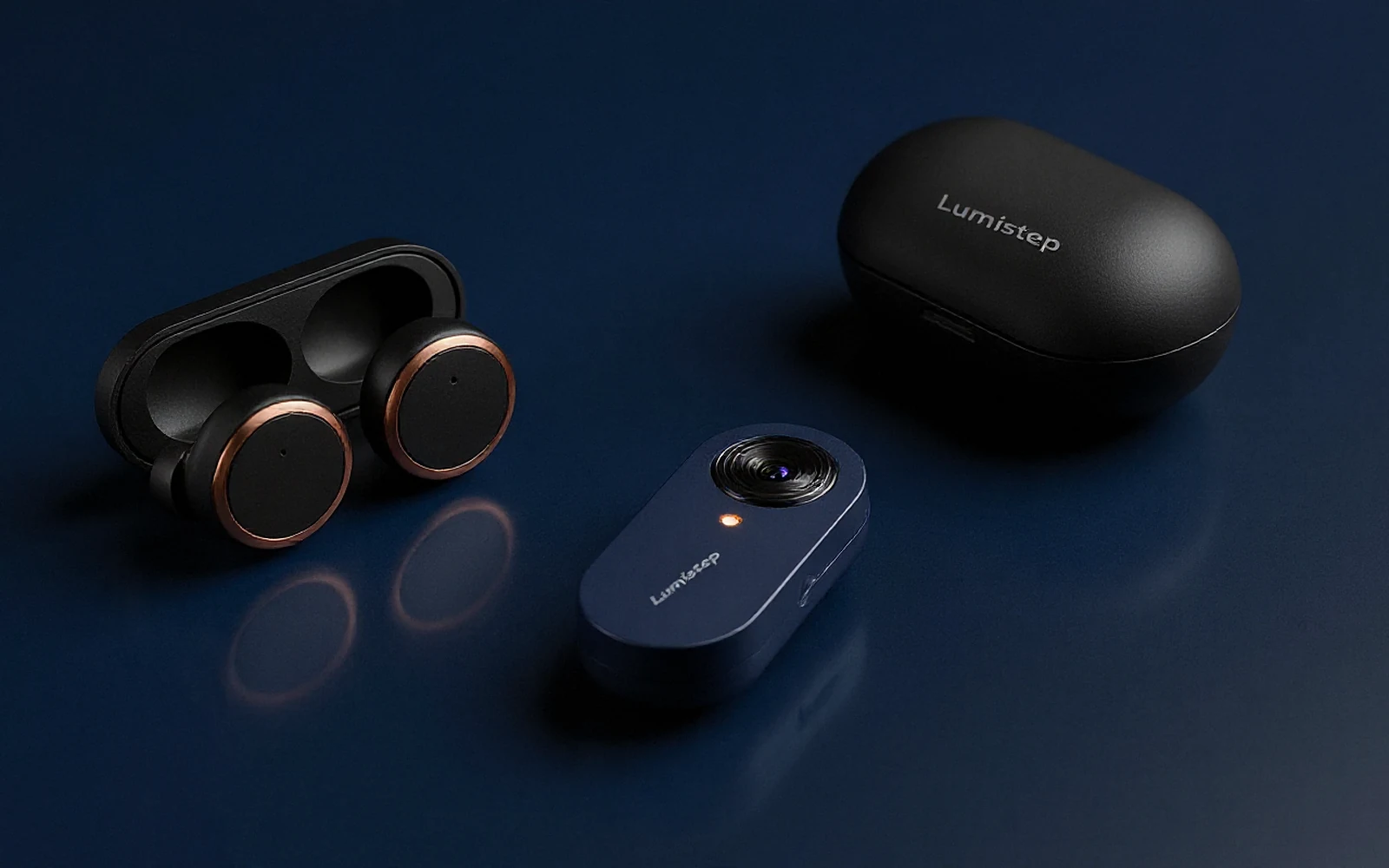
The Lumistep family
Made to work together.
Lumistep
Get involved
Three ways to help blind and low-vision people walk, read and travel on their own.
For people and families
Join the waitlist
Hear first about field trials and the first production kits, and help shape what we build.
Join the waitlistFor charities, trainers and sponsors
Support Lumistep
Sponsor a kit, host a field trial or partner with us to reach the people who need it most.
Ways to supportFor investors
Invest in Lumistep
We are raising our first round to complete engineering and field trials. Let's talk.
For investors